


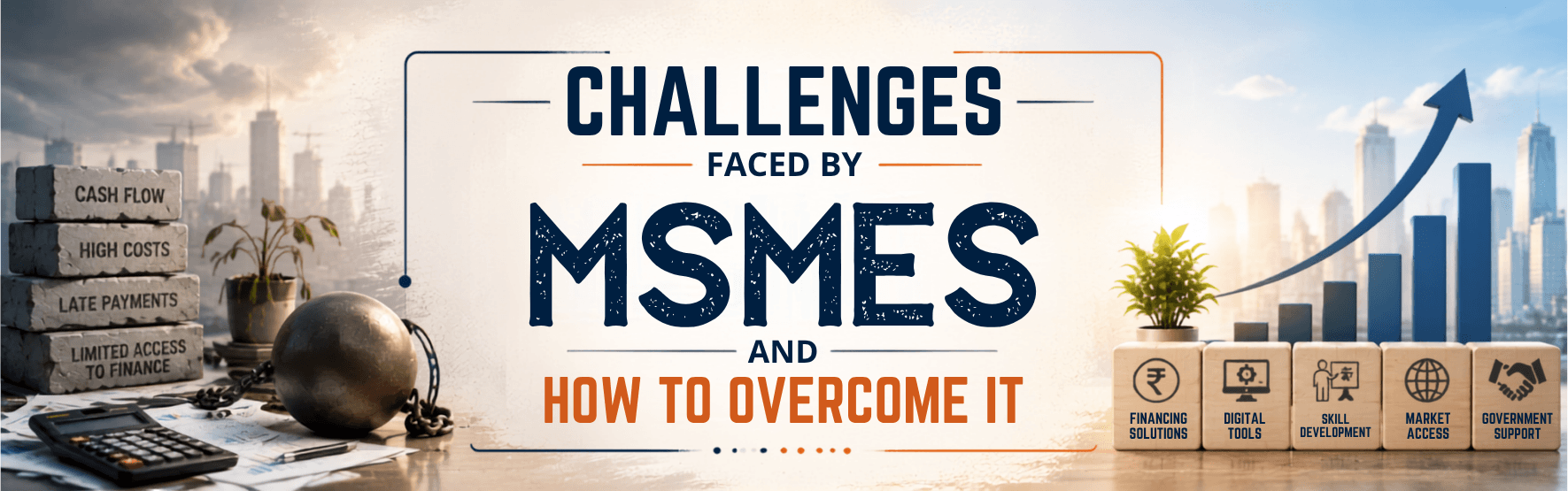
India’s Micro, Small, and Medium Enterprises (MSMEs) are often called the backbone of the economy, and for good reason. From manufacturing units and service providers to exporters and traders, MSMEs contribute significantly to employment generation, industrial growth, and economic development.
However, despite their importance, many MSMEs continue to face serious financial challenges that limit growth, profitability, and long-term sustainability. Access to credit remains difficult, payments are frequently delayed, compliance costs continue to rise, and cash flow management has become increasingly complex.
As we move through 2026, understanding these challenges and adopting the right financial solutions has become critical for business survival and growth. In this article, we explore the top financial challenges faced by MSMEs in India and the practical ways businesses can overcome them.
India’s MSME Sector – Powerful Yet Financially Fragile
India’s MSME ecosystem has witnessed remarkable growth over the last few years. As of early 2026, more than 6.2 crore enterprises are registered under Udyam, making it one of the largest MSME ecosystems globally.
The revised MSME classification, effective from April 2025, defines enterprises as:
- Micro Enterprises: Annual turnover up to ₹5 crore
- Small Enterprises: Annual turnover up to ₹50 crore
- Medium Enterprises: Annual turnover up to ₹250 crore
While these businesses contribute nearly 30% of India’s GDP and employ millions of people, many continue to operate with limited financial resources, making them vulnerable to market fluctuations and liquidity pressures.
Challenge 1 – The ₹30 Lakh Crore Credit Gap
One of the biggest obstacles for MSMEs remains access to formal credit.
Industry estimates suggest that India’s MSME sector faces a credit gap of nearly ₹30 lakh crore. Despite multiple government initiatives, a significant portion of small businesses still struggle to secure timely financing.
Why Banks Won’t Lend Easily
According to recent industry studies, only about 14–16% of MSMEs have access to formal credit channels.
Banks often consider MSMEs high-risk borrowers because they may lack:
- Strong credit histories
- Audited financial statements
- Established banking relationships
- Sufficient collateral
Even when loans are approved, the disbursement process can take weeks or months, causing businesses to miss time-sensitive opportunities.
The Collateral Trap
For first-generation entrepreneurs, collateral remains one of the biggest barriers. Many business owners do not own commercial property or valuable assets that can be pledged against loans. While schemes such as CGTMSE and MUDRA have improved access to funding, awareness and adoption remain uneven across the country.
An increasingly popular alternative is invoice-based financing solutions that rely on receivables rather than physical assets, helping businesses access working capital without pledging collateral.
Challenge 2 – Delayed Payments: The Silent Cash Flow Killer
Delayed payments continue to be one of the most damaging financial issues for MSMEs.
Scale of the Problem
Under the MSMED Act, buyers are required to clear payments within 45 days. However, enforcement remains a challenge. Industry estimates suggest that more than ₹10 lakh crore remains locked in unpaid MSME receivables at any given time. Large corporates and public sector entities often extend payment cycles to 60, 90, or even 120 days, putting immense pressure on suppliers.
The Domino Effect
When payments are delayed, the impact spreads across the entire business.
Stuck receivables often lead to:
- Delayed supplier payments
- Reduced production capacity
- Inability to accept new orders
- Increased dependence on expensive borrowing
Although the MSME Samadhaan portal provides a dispute resolution mechanism, many businesses hesitate to pursue legal action against important customers.
This persistent challenge is precisely why the TReDS ecosystem was introduced—to unlock cash trapped in approved invoices.
Challenge 3 – Working Capital Volatility
Managing working capital remains a daily struggle for many MSMEs. Unlike large corporations with dedicated finance teams, most small businesses operate with limited financial planning capabilities.
Several factors contribute to working capital instability:
- Seasonal demand fluctuations
- Irregular customer orders
- Inventory accumulation
- Rising input costs
- Delayed GST input tax credits
As a result, businesses often find themselves in situations where growth opportunities exist but the funds required to execute them are unavailable.
Many MSMEs lose valuable expansion opportunities simply because they cannot arrange capital quickly enough.
Challenge 4 – High Cost of Borrowing
● MSMEs pay 15–28% p.a. from informal/NBFC lenders vs 10–12% for large corporates
● Processing fees, insurance, and hidden charges inflate effective rates
● Total MSME credit demand: ₹69 trillion — only ₹14.5 trillion formally met
When formal credit is unavailable, MSMEs often turn to alternative lenders. Unfortunately, this usually comes at a high cost.
While large corporates may access financing at rates between 10–12% annually, MSMEs frequently pay anywhere from 15–28% through informal channels and certain non-banking lenders.
The actual borrowing cost can become even higher due to:
- Processing charges
- Documentation fees
- Insurance costs
- Hidden administrative expenses
With total MSME credit demand estimated at approximately ₹69 trillion and only a fraction being formally serviced, the funding gap continues to push many businesses toward expensive financing options.
Challenge 5 – Regulatory & Compliance Burden
Running a business today involves much more than selling products and serving customers. MSMEs must comply with a growing number of regulations covering taxation, labour laws, environmental norms, reporting requirements, and industry-specific standards.
Studies indicate that businesses may deal with over 1,400 compliance obligations annually, costing some enterprises between ₹10 lakh and ₹13 lakh each year.
Common challenges include:
- GST filing complexities
- Input Tax Credit disputes
- State and central regulatory overlaps
- Documentation requirements
- Audit and reporting obligations
While formalization through Udyam Registration has improved transparency, documentation and compliance management remain major operational challenges.
Challenge 6 – Low Digital & Financial Literacy
Technology adoption has improved significantly, but many MSMEs still rely on manual systems for bookkeeping and financial management.
According to industry surveys, nearly 65% of MSMEs identify financial constraints as a major barrier to digital adoption.
This creates several problems:
- Poor financial visibility
- Difficulty obtaining credit
- Limited access to fintech solutions
- Inefficient cash flow tracking
Many businesses are still unaware of modern financing tools such as:
- TReDS platforms
- Account Aggregator framework
- GST-linked lending solutions
- Digital supply chain finance
Improving financial literacy is becoming just as important as improving access to capital.
Challenge 7 – Supply Chain & Global Shocks
Global disruptions continue to affect Indian businesses. Many MSMEs depend on imported raw materials and components, making them vulnerable to geopolitical events, shipping delays, currency fluctuations, and global market instability.
With limited cash reserves, even a two-week disruption can significantly impact production schedules.
Additionally, India’s logistics costs remain around 13–14% of GDP, substantially higher than the global average of approximately 8%.
For businesses operating on thin margins, supply chain disruptions can quickly translate into financial stress.
Government Schemes MSMEs Must Know in 2026
Several government initiatives continue to support MSME growth and financial inclusion.
CGTMSE
Provides collateral-free credit support through guaranteed lending mechanisms.
MUDRA / PMMY
Loan limits have been expanded, enabling eligible businesses to access funding of up to ₹20 lakh under certain categories.
MSME Samadhaan
Offers a platform for reporting delayed payment disputes and seeking resolution.
Udyam Registration
Provides official MSME recognition and access to numerous government benefits and incentives.
Budget 2025–26 Initiatives
Recent measures include:
- MSME Credit Card initiatives
- ₹10,000 crore Fund of Funds support
- Expanded credit access measures
- Enhanced digital financing initiatives
While these schemes are valuable, businesses often require faster and more flexible solutions to manage day-to-day cash flow requirements.
The Smartest Fix for Delayed Payments – TReDS via RXIL
Among all the financial challenges discussed above, delayed payments remain one of the most immediate and solvable problems.
This is where TReDS plays a transformative role.
What Is TReDS?
Trade Receivables Discounting System (TReDS) is an RBI-regulated electronic platform that enables MSMEs to convert approved invoices into immediate working capital.
India currently has three authorized TReDS platforms:
- RXIL
- M1xchange
- Invoicemart
The process is simple:
- MSME uploads an approved invoice.
- Buyer confirms the invoice.
- Multiple financiers place competitive bids.
- MSME selects the best financing rate.
- Funds are typically received within 24 hours after accepting the suitable bid.
- The buyer pays the financier on the invoice due date.
Why TReDS Is a Game-Changer
TReDS solves several MSME financing challenges simultaneously.
- No Collateral Required: Financing is based on the buyer’s creditworthiness rather than the MSME’s assets.
- Without Recourse Financing: Once financed, the MSME does not bear the repayment risk if the buyer defaults.
- Competitive Financing Rates: Multiple financiers compete to offer funding, helping drive rates lower.
- Off-Balance-Sheet Funding: The transaction does not create traditional debt on the MSME’s books.
- RBI-Regulated Framework: The entire process operates within a transparent and compliant ecosystem.
Why RXIL?
RXIL addresses the challenge of delayed payment by enabling MSMEs to access timely liquidity against confirmed receivables through a transparent, paperless, and RBI-regulated ecosystem.
As India’s first RBI-approved TReDS (Trade Receivables Discounting System) platform, RXIL supports a wide national network, with over 94,000+ MSMEs registered across more than 1,160 cities, along with 3,600+ large corporates and PSUs. More than 70 banks and NBFCs participate as financiers, ensuring competitive bidding and transparent pricing for every approved receivable.
Key advantages of the RXIL:
- Seamless ERP integration capabilities
- No additional burden on MSME sellers
- Fully digital and transparent transaction process
- Collateral-free financing
- Independence to choose the most suitable bid on your invoice.
For MSMEs struggling with delayed payments, RXIL enables businesses to unlock cash from invoices they have already earned rather than waiting months for payment realization.
Register at RXIL and transform approved invoices into working capital when your business needs it most.
Other Solutions Worth Exploring in 2026
While TReDS addresses delayed payments effectively, MSMEs should also consider complementary financial tools.
- Account Aggregator Framework: Enables secure sharing of financial data for faster loan approvals.
- GST-Linked Lending: Uses GST transaction history to improve credit assessment and financing access.
- Supply Chain Finance: Provides liquidity across the supplier ecosystem through structured financing arrangements.
- SIDBI Support Programs: Offer sector-specific funding and development initiatives for eligible enterprises.
Combining these solutions with TReDS can create a stronger and more resilient financial foundation.
Conclusion
From the ₹30 lakh crore credit gap and delayed payments to rising compliance costs and supply chain disruptions, the obstacles are significant. Fortunately, modern financial solutions are making it easier for businesses to overcome these barriers.
Among these solutions, TReDS stands out as one of the most practical tools for improving liquidity without increasing debt or requiring collateral.
For MSMEs looking to strengthen cash flow, reduce financing stress, and accelerate growth, RXIL provides a trusted, RBI-regulated platform that converts approved invoices into immediate working capital.
Instead of waiting months for payments, businesses can put their earned revenue to work today.
FAQ
1. What is the biggest financial challenge for MSMEs in India?
Delayed payments and limited access to formal credit are among the biggest financial challenges faced by MSMEs in India.
2. How does TReDS help MSMEs with cash flow?
TReDS enables MSMEs to receive early payment against approved invoices, improving liquidity without taking traditional loans.
3. Is TReDS registration mandatory for MSMEs?
No. However, registering on a TReDS platform can significantly improve cash flow management and access to working capital.
4. What is the MSME credit gap in India in 2026?
Industry estimates place the MSME credit gap at approximately ₹30 lakh crore, highlighting the need for alternative financing solutions.
5. Which is the best TReDS platform in India?
RXIL is widely recognized as one of India’s leading TReDS platforms, backed by SIDBI and NSE and trusted by thousands of businesses.
6. How can MSMEs improve working capital without a loan?
MSMEs can improve working capital through invoice discounting, TReDS financing, supply chain finance solutions, and better receivables management practices.